
Last updated September 20, 2026
Free on-site gate assessment - hinges, posts, and your LiftMaster or Nice gate operator checked before anything is quoted
The assessment is free and the quote is the invoice.


 Before
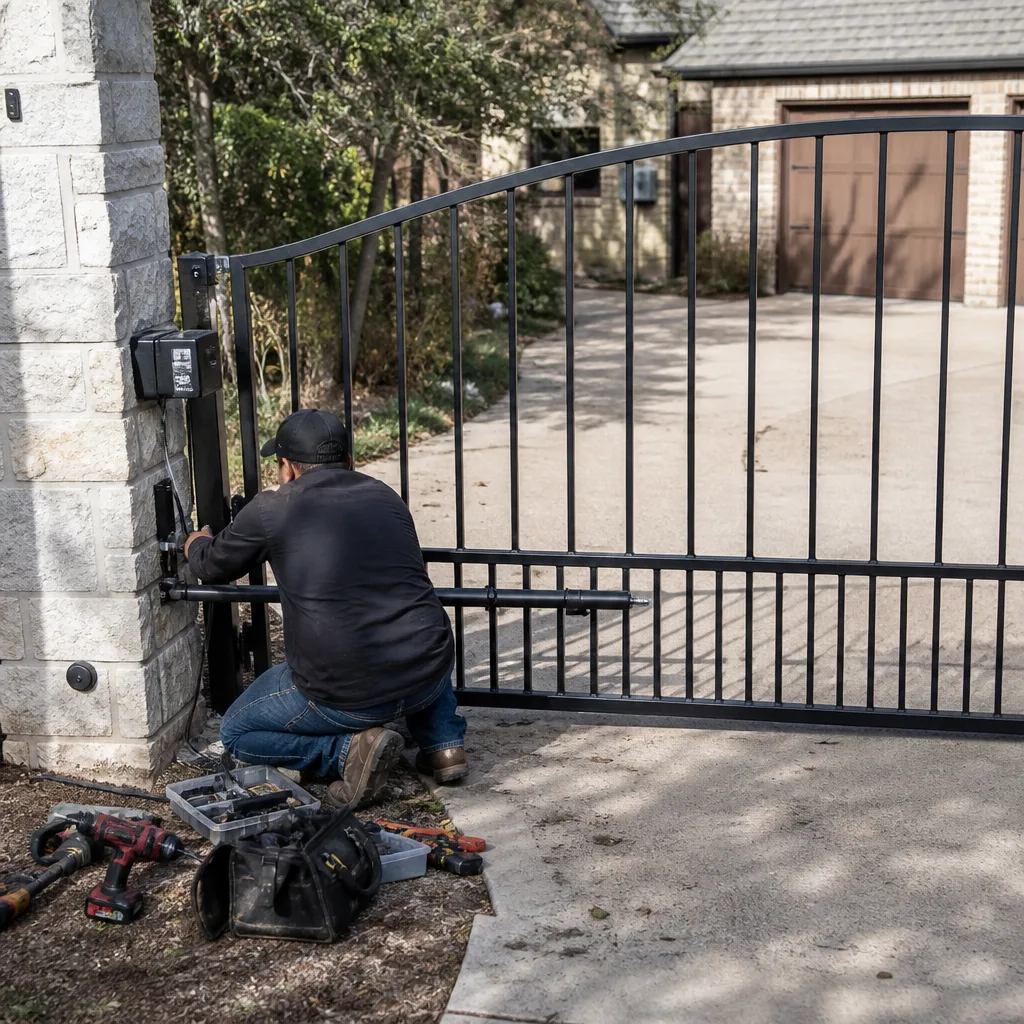 After
After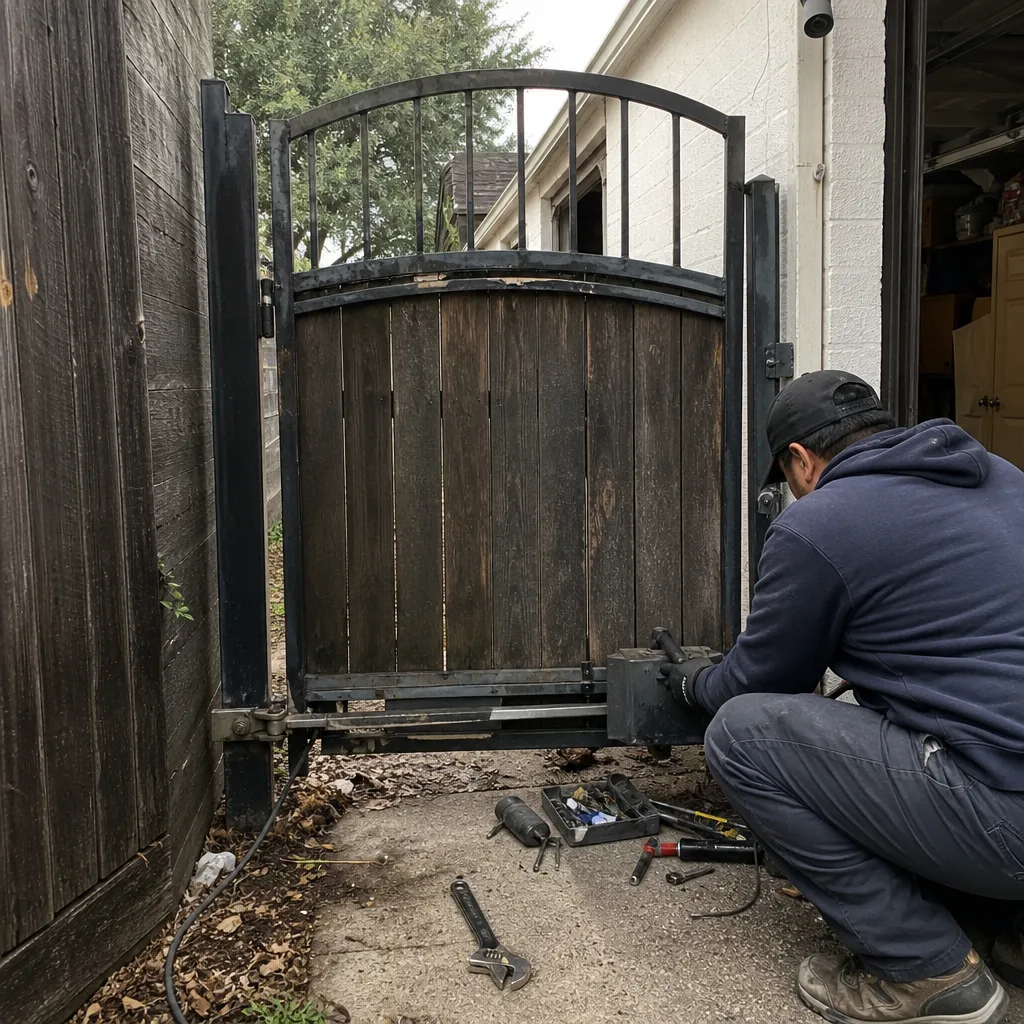 Before
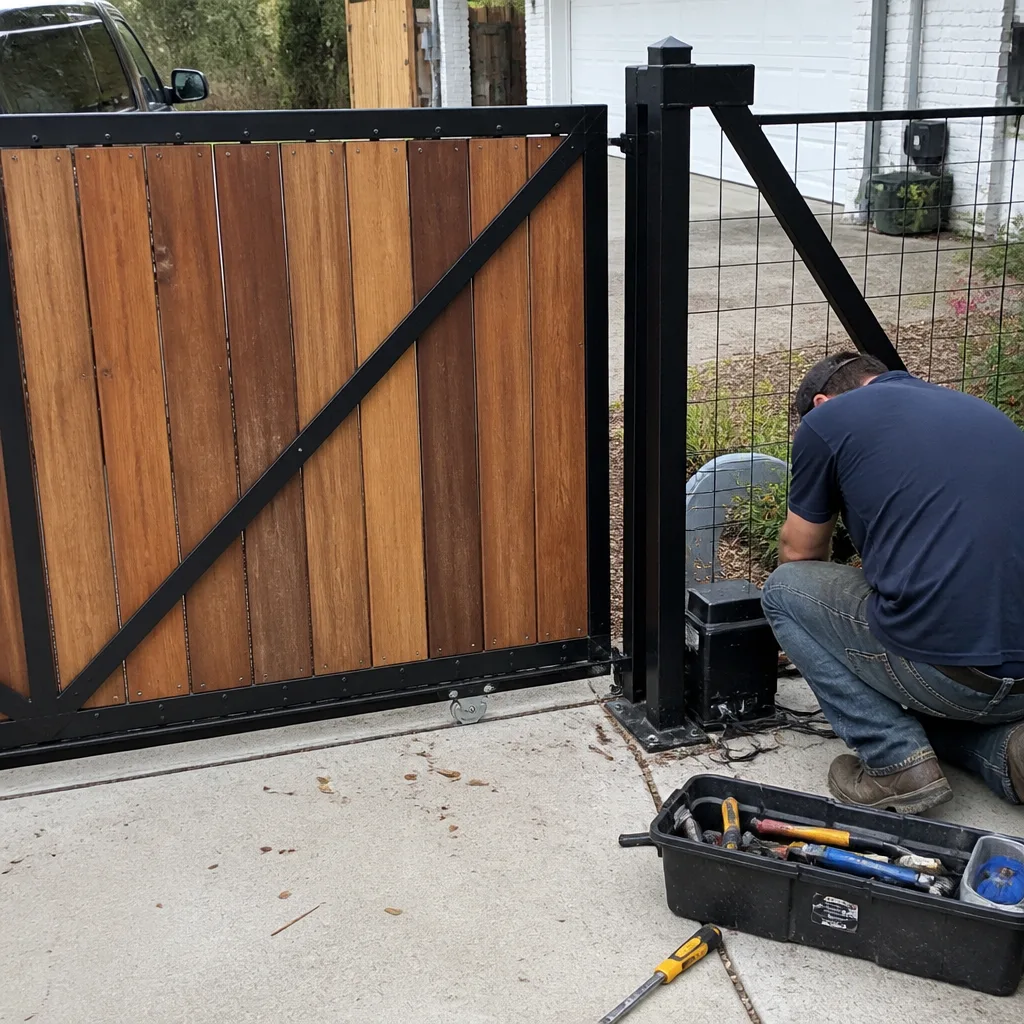 After
After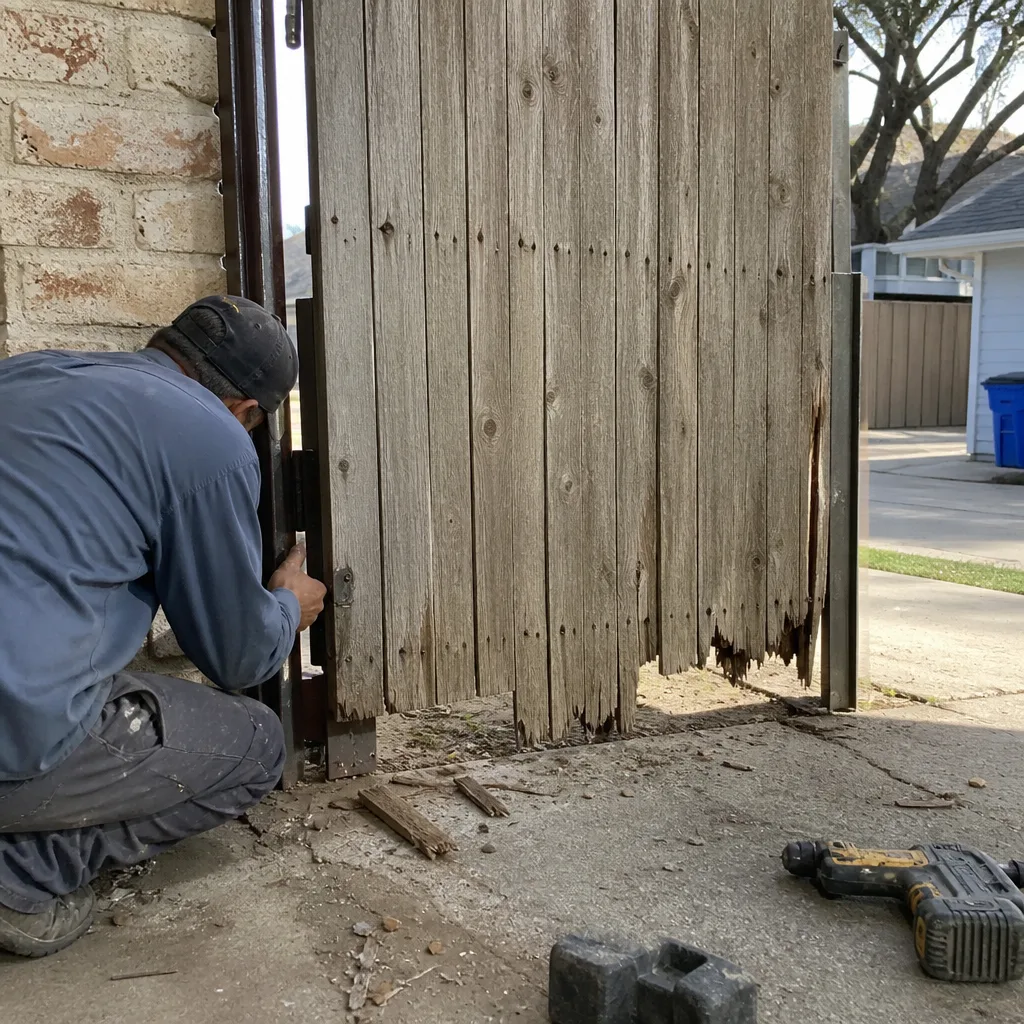 Before
 After
AfterHow to Hire a Gate Repair Contractor in Fort Worth: A Step-by-Step Guide
The most expensive gate repair most Fort Worth homeowners ever pay for is the one that fixes what the previous contractor should have found, and didn’t document. A swing gate that drags, a motor that hums but won’t move, a keypad that works only when it rains: each of these has a paper trail that should have been left behind. This guide walks through the hiring process in the order that protects you: what to request before you authorize work, what questions separate a gate specialist from a handyman who also fixes gates, and what the final sign-off should include so the next technician never has to start from zero. For related reading, see our Complete Guide to Gate Repair in Fort Worth.
Quick Answer
Hire a gate repair contractor in Fort Worth by requiring three documents before any work begins: written diagnostic findings, an itemized written estimate, and a scope of what will not be addressed in that visit. Then confirm licensing and insurance, verify the contractor works on your specific automation brand, and refuse to authorize any job that starts with a verbal number. At the end, request a photo record and written notes so the repair is documented, not just performed.
Table of Contents
- The Three Documents to Request Before Authorizing Any Work
- Questions That Separate a Gate Specialist From a General Handyman
- Red Flags Specific to the Gate Repair Industry
- How to Verify Licensing and Insurance for Gate Work in Texas
- How to Structure the Final Sign-Off
- What Gate Repair Actually Costs in Fort Worth
- Common Mistakes to Avoid
- When to Call a Professional
BeforeAfterThe Three Documents to Request Before Authorizing Any Work
A gate repair should start the way any skilled-trade job starts: with a written record of what the technician found, what it will cost to fix, and what will be left alone. Most Fort Worth homeowners skip this step because the gate is making a noise, the technician seems confident, and the driveway is blocked. That’s exactly when the paperwork matters most.
Here are the three documents to ask for before you authorize a single hour of labor:
- Written diagnostic findings. This is the technician’s account of what was tested, what was measured, and what failed. For a gate motor that won’t close, a legitimate finding reads: “Limit switch set 12 degrees past full travel; control board LED shows obstruction signal; capacitor within spec.” A finding that just says “motor is bad” is not a diagnosis. In Fort Worth, where summer heat and winter freeze cycles stress gate hardware differently than coastal climates, the diagnostic should reference what the technician actually observed on your specific setup.
- Itemized written estimate. Line items, not a lump sum. You should see labor broken out from parts, and the part number or brand listed for every replacement component. LiftMaster, DoorKing, Elite, and Mighty Mule all have different control board prices and different labor implications. An itemized estimate lets you check whether the part listed matches what’s installed, and it gives you a reference point if you want a second opinion.
- Scope of what will not be addressed. This is the document most homeowners never think to ask for, and it’s the one that prevents the “while we’re here, we also found…” invoice. If the technician notices a hinge crack, a sagging weld, or a photo-eye that’s near the end of its life but still functional, that should be written down as observations, not silently added to the job. A clear scope boundary means the quote covers exactly what was agreed, and anything else requires a separate conversation and a separate price.
At Vance Gate Repair Fort Worth, every visit begins with these three documents under what we call The Haven Standard. Clause 1 is direct: have it in writing. The flat price is handed to you before any work starts, not after the gate is apart and the urgency has shifted in the contractor’s favor.
Questions That Separate a Gate Specialist From a General Handyman

Fort Worth has no shortage of handymen who will take a look at a gate. The difference between a handyman and a gate specialist becomes visible within three questions. Ask them in this order, and pay attention to how specific the answers get.
Question 1: “How do you calibrate the limit switches on my operator after the repair?”
Limit switches tell the motor where the gate is in its travel. Set them wrong, and the gate slams into the stop, stalls before it closes, or reverses at the wrong position. A gate specialist can explain the calibration procedure for your specific brand. A handyman will usually say something general about “adjusting the settings.” If the answer doesn’t include the words “limit switch” and a brand name, keep looking.
Question 2: “Where do you source control boards for my operator brand?”
This question separates the contractor who repairs gates from the contractor who replaces them. A specialist knows whether DoorKing boards are available through distribution channels, whether Elite boards need to be ordered direct, and whether Mighty Mule parts are stocked locally in Fort Worth or shipped. A handyman who doesn’t know the answer will often pivot to “you probably need a new opener,” which is a sales pitch disguised as a diagnosis.
Question 3: “Do you carry wiring diagrams for my operator brand?”
Wiring diagrams matter because no technician remembers every terminal on every board. A specialist who works on LiftMaster, FAAC, BFT, Linear, Ghost Controls, DoorKing, Elite, and Mighty Mule systems keeps the diagrams accessible on the truck or on a tablet. If the answer is “I don’t need a diagram, I’ve done hundreds of these,” that confidence is worth exactly nothing when the board has a revision you haven’t seen before. Adrian Vance, who founded Vance Gate Repair services after years on commercial access-control sites, still opens the diagram before touching control wiring. Not because he doesn’t know the systems. Because he knows enough to know that revisions get misremembered.
If you’re not sure who to call, start with our Gate Repair in Fort Worth page for a plain explanation of what we inspect and what we don’t.
Red Flags Specific to the Gate Repair Industry
Every trade has its dishonest operators, but gate repair has a specific pattern of bad behavior you can spot in the first fifteen minutes of a visit. Here are the flags we hear about most often from Fort Worth homeowners who called us after a bad experience elsewhere.
- Verbal-only estimates. If the contractor won’t write anything down before starting, the only reason is that the number needs room to grow. A written estimate fixes the price at a moment in time. A verbal estimate fixes nothing. Walk away, or ask them to put it in writing and then call someone else.
- Flat-rate labor that obscures parts markup. “Labor: $350. Parts: did not itemize.” That invoice is hiding something. Reputable gate technicians itemize parts by brand and part number. If the invoice says “parts” with a single number next to it, you paid a markup you weren’t told about.
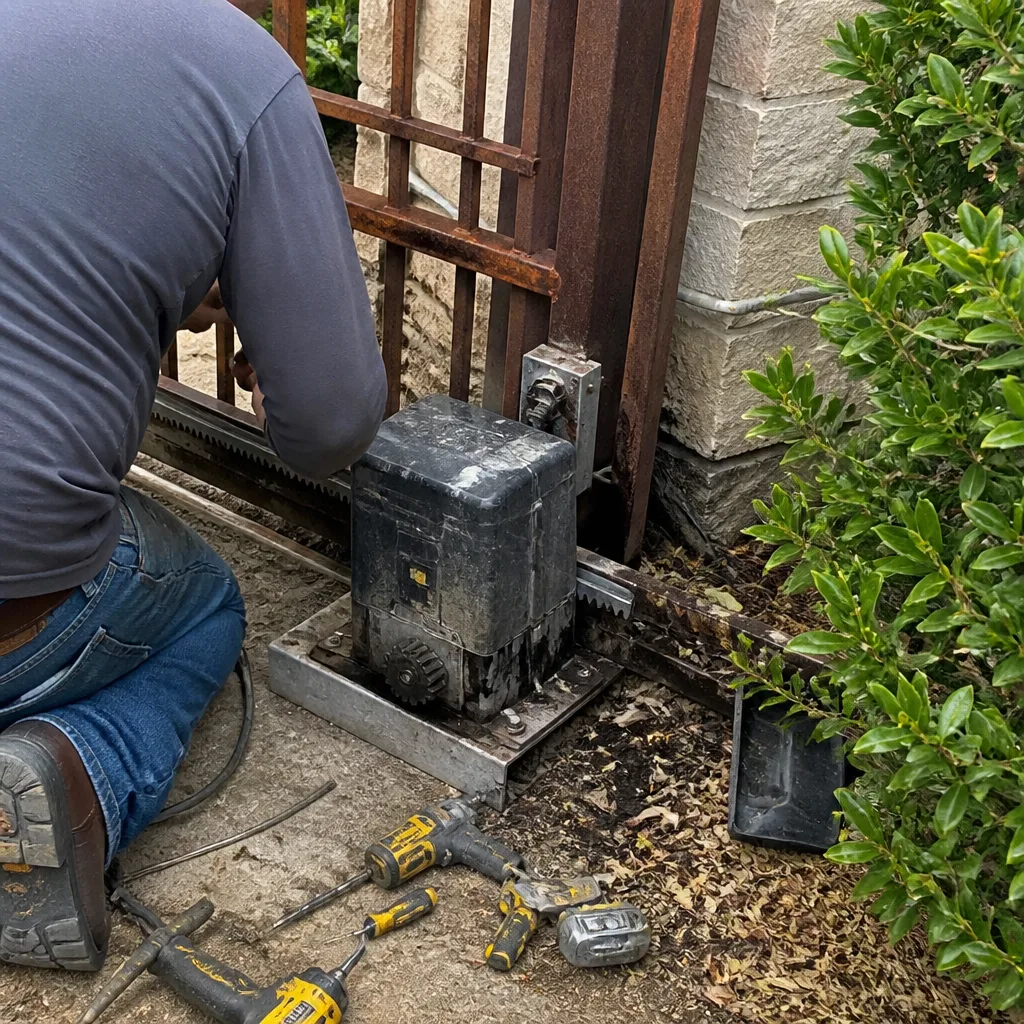
- Refusal to photograph the before-state. This one is specific and it matters. A technician who won’t photograph the wiring before they touch it is either careless or planning to blame you for a pre-existing problem. Ask directly: “Will you photograph the board and the wiring before you start?” If the answer is no, that’s a red flag. Photographic documentation protects you and the contractor, and there’s no legitimate reason to skip it.
- Diagnosis before inspection. If you describe the symptom over the phone and the technician says “sounds like you need a new operator” before anyone has looked at the gate, you’ve been sold, not diagnosed. In Fort Worth, heat stress on capacitors and cold-weather contraction on welds create failures that look identical from a phone call and completely different in person.
- No written scope of what’s excluded. If the estimate says “repair gate” and nothing else, the job has no boundaries. A proper scope names what’s fixed, and equally important, what’s observed but not addressed in this visit.
How to Verify Licensing and Insurance for Gate Work in Texas
Texas doesn’t license gate installers the way it licenses electricians or plumbers, which means the verification burden falls on the homeowner. Here’s what to check and what it actually tells you.
For gate repair and gate motor work: Confirm the company carries general liability insurance for the specific work being performed. Ask for a certificate of insurance, not a verbal assurance. Any legitimate Fort Worth gate contractor can produce one within a day. Check that the policy covers gate automation, not just general contracting, because motors and control boards are treated differently than fence work on some policies.
For electrical wiring that extends beyond the gate operator’s low-voltage control side: If the job involves running new line-voltage power to the gate, trenching conduit to a new location, or adding a subpanel, that work falls under an electrical license in Texas. A gate technician can connect the low-voltage side of the system, but the line-voltage side belongs to a licensed electrician. A competent gate contractor will tell you when the scope crosses that line. One who doesn’t mention it is either unaware of the boundary or hoping you won’t ask.
The distinction matters in Fort Worth because many homes in areas like Monticello, Tanglewood, and Westcliff were built decades ago, and the original gate electrical runs are sometimes buried without proper conduit. The residential gate technician’s job is to identify that condition. The licensed electrician’s job is to fix it. Ask your contractor which side of that line your project falls on.
How to Structure the Final Sign-Off
The repair isn’t finished when the gate moves. It’s finished when you have the documentation that lets the next technician start from knowledge, not guesswork. Here’s what to request before you sign the completion form and pay the final invoice.
- The photo log. Every worthwhile gate technician photographs the before-state, the mid-repair state, and the after-state. You want wiring, board, limit switch positions, and any replaced hardware. If the documentation shows the limit switch was set to a specific reading, that number is gold for future repairs. It tells the next technician where things were, not just that they were “adjusted.”
- Updated wiring notes. If any wiring changed, the diagram should reflect it. This matters more on older systems and custom gates where the original wiring diagram may not match what’s actually in the ground. A technician who documents wire colors and terminal positions at sign-off has just saved the next repair at least an hour of tracing.
- Limit readings and torque settings. When limit switches are calibrated, the final positions should be written down. Swing gates, slide gates, and vertical pivot gates all use different reference points. The written reading means the next technician can verify the setting in two minutes instead of recalibrating from scratch.
- A written itemized invoice matching the estimate. The final price should look like the estimate unless something was added with your written approval. If the invoice line items don’t match the estimate line items, ask why before you pay.
We end every visit with exactly this documentation under Clause 4 of The Haven Standard (Evidence on every job), as detailed in our Seasonal Gate Repair Care for Fort Worth: Year-Round Homeowner’s Guide. Photo log, wiring notes, limit readings, written invoice. It’s the habit Adrian Vance built working commercial access control, where a site manager would not accept a verbal account of what was fixed. Residential gates deserve the same standard.
What Gate Repair Actually Costs in Fort Worth
Contractors quote gate work in Fort Worth the way they quote everything else: with enough range that the number can move. Homes in north Fort Worth neighborhoods, the Near Southside, and the older streets of Arlington Heights see different gate systems than the newer builds in Alliance or Walsh Ranch, and the price reflects that. Here’s a realistic look at what typical repairs cost in this market.
- Limit switch adjustment or replacement: $120 to $275, depending on brand and whether the switch mounts externally or inside the operator housing.
- Photo-eye realignment or replacement: $110 to $220. The infrared beam that stops the gate if something crosses the path is one of the most frequent culprits in Fort Worth, especially on driveway gates where landscaping shifts with the clay soil through summer and winter cycles.
- Control board replacement: $250 to $600. DoorKing and Elite boards sit at the affordable end. LiftMaster boards for higher-end residential operators run higher. The board is often the second thing replaced unnecessarily because a cheaper failure was missed.
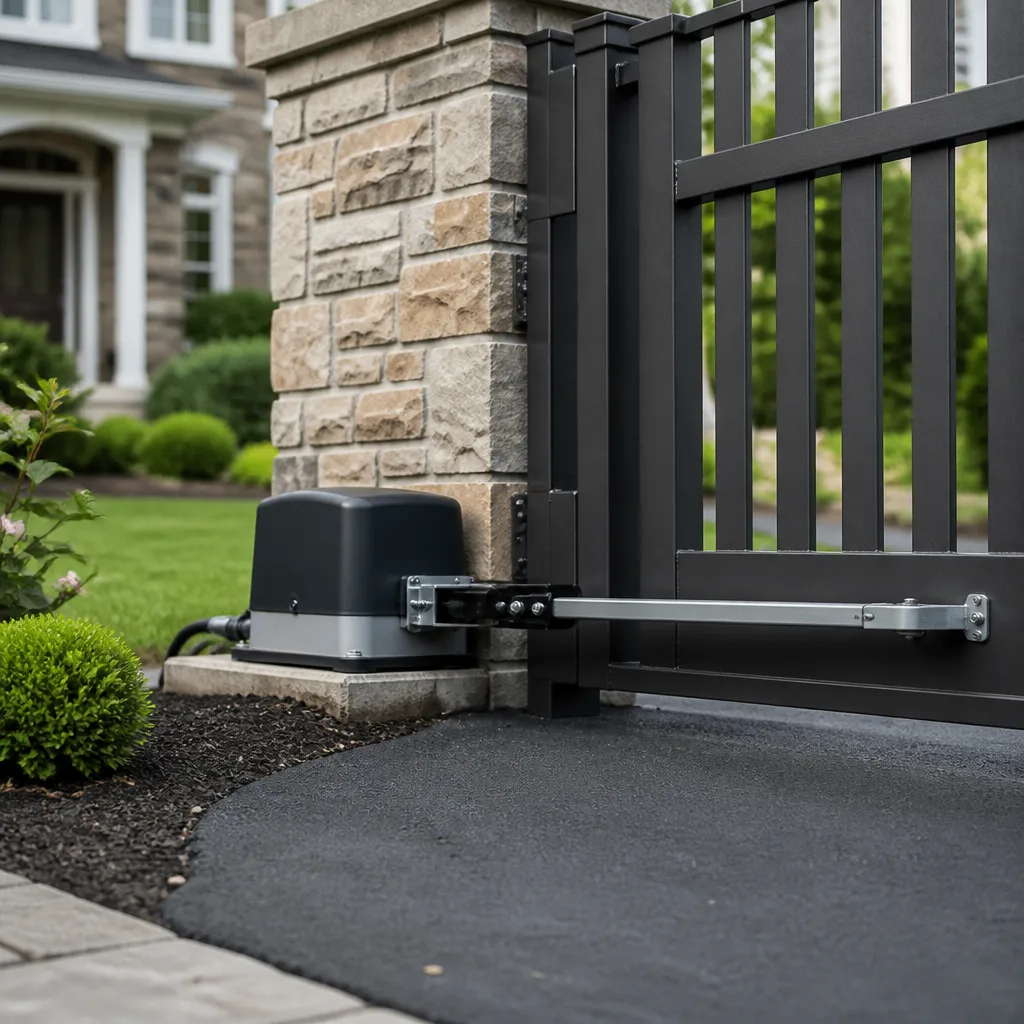
- Swing-gate motor replacement: $650 to $1,400, depending on the brand and whether the arm bracket is intact. Mighty Mule starts lower; LiftMaster and higher-end commercial-grade operators run higher. The bracket matters because if the mounting point is damaged, the new motor fails the same way as the old one.
- Weld repair on a steel gate frame: $150 to $450 for a typical crack or pulled hinge, with the spread depending on material thickness and powder-coat touch-up.
Most swing-gate motor replacements in Fort Worth land between $850 and $1,150 when the bracket is intact and the operator is a mid-tier residential brand. The price prints on the estimate before the work begins, and that’s the number you pay unless you approve a change in writing.
If the gate itself needs to be replaced rather than repaired, read our Gate Installation in Fort Worth page for the full breakdown of materials, labor, and what a written installation scope should include.
Common Mistakes to Avoid
- Paying for a “rebuild” when the failure was a $12 capacitor. Gate motors fail at the component level first. A technician who says “the motor is shot, you need a whole new unit” without showing you the test readings is guessing. Ask for the diagnostic numbers.
- Replacing an operator before checking the gate itself. In Fort Worth, gate structure fails before motors do. The clay soil moves, posts shift, hinges bind, and the motor burns itself out fighting a gate that doesn’t swing freely. If the gate is heavy to move by hand, the problem is the gate, not the operator. Replacing the motor without fixing the binding is a one-year repeat failure.
- Choosing a contractor based on who answered the phone first. Availability at 2 PM on a Tuesday tells you nothing about skills. A specialist who calls back in an hour is worth more than a handyman who shows up in twenty minutes.
- Allowing the technician to start work without writing down what they found. If there’s no record of the before-state, you have no reference for whether the repair actually changed anything.
- Signing off on “recalibrated the photo-eye” without knowing the beam was tested. Ask to see the beam test. A properly aligned photo-eye stops the gate when the beam is interrupted, and the technician should demonstrate that before leaving.
- Letting a one-brand installer talk you out of your current brand. If a contractor only works on LiftMaster and your gate has a DoorKing system, the answer will always be “you need a new LiftMaster.” That’s not a diagnosis. It’s a sales limitation.
When to Call a Professional
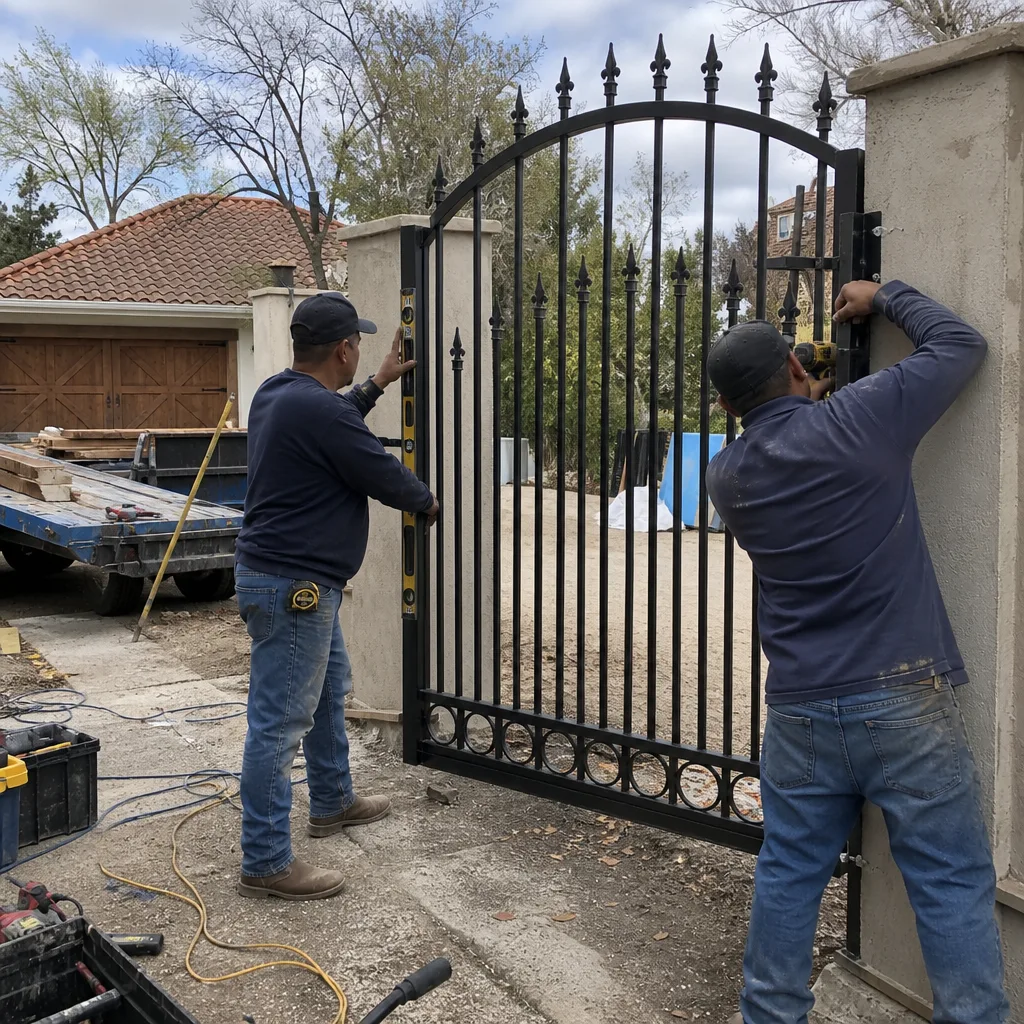
Call a gate technician when the gate no longer moves predictably: it hesitates, stalls, reverses at the wrong position, or makes a grinding noise that wasn’t there a week ago. Call the same day if the gate stops mid-travel and blocks the driveway, or if the safety reverse stops working and the gate closes on anything in its path. A gate that won’t open is an inconvenience. A gate that closes on a child or a pet is an emergency. High-tension springs and cables on some swing and vertical-pivot gates contain stored energy, and a spring that lets go during DIY repair can cause serious injury. If the repair involves tensioned hardware, call a trained professional rather than attempting the adjustment yourself. Vance Gate Repair Fort Worth offers free estimates in Fort Worth. Call (817) 476-9945 and a live person answers, any hour.
Frequently Asked Questions
Most gate repairs in Fort Worth run between $120 and $1,400 depending on the component. Limit switch adjustments and photo-eye realignments sit at the low end around $120 to $275. Control board replacements run $250 to $600. A full swing-gate motor replacement usually lands between $850 and $1,150 when the bracket is intact. The exact price depends on the operator brand and what the diagnostic shows. Call (817) 476-9945 for a written estimate based on your specific gate.
Check three things: a certificate of insurance for gate automation work, a written estimate with itemized parts and labor, and the answer to the limit switch question. If the contractor calibrates limit switches, sources control boards by brand, and carries wiring diagrams, you’re talking to a gate specialist. If the answers are vague or the estimate is verbal, keep looking.
A gate technician handles the gate hardware, the operator, the control board, the low-voltage wiring, and the safety devices. A licensed electrician handles line-voltage power: running new electrical service to the gate, trenching conduit, adding a subpanel. The right contractor knows which side of that line your job falls on and tells you when an electrician needs to be involved.
Repair is the right call when the gate structure is sound and the failure is in a component: motor, board, limit switch, photo-eye, hinge. Replacement is the right call when the steel frame is rusted through, multiple welds have failed, or the gate is undersized for the opening and binding against the posts. A written diagnostic answers this definitively. Don’t let a technician recommend replacement before inspecting the structure.
A proper gate specialist works across brands rather than steering you toward one. If the company only handles one manufacturer, their diagnosis will always point toward replacing your existing system with theirs. That’s a sales funnel, not a repair recommendation. Look for a contractor who services LiftMaster, DoorKing, Elite, Mighty Mule, and the other major residential operators.
You should receive a photo log showing the before-state, the mid-repair state, and the after-state; written notes on any wiring changes; limit switch readings and torque settings from the final calibration; and an itemized invoice that matches the estimate. If the technician leaves without documenting what was found and what was changed, the next repair starts from zero. Ask for the documentation before you sign off and pay.
The Bottom Line
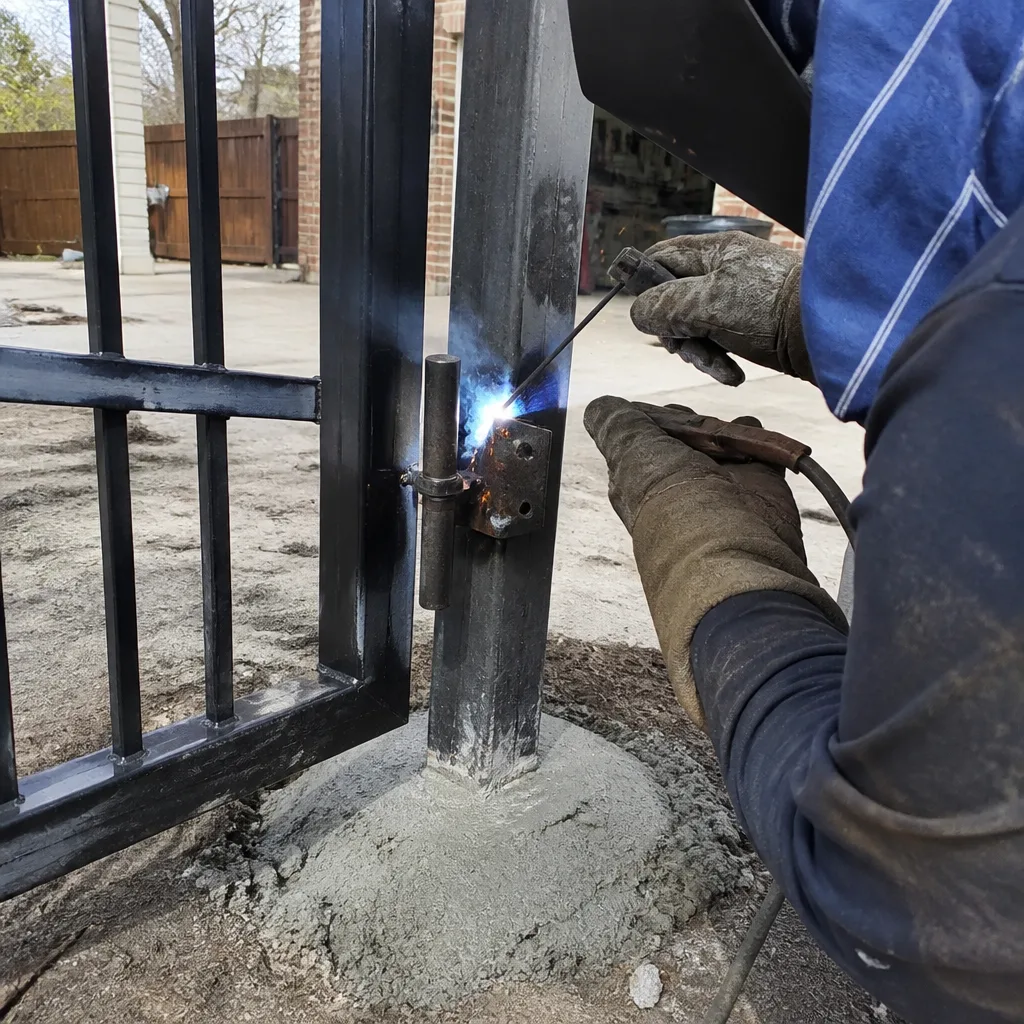
Hiring a gate repair contractor in Fort Worth is a documentation problem first and a price problem second. The right contractor hands you written findings, an itemized estimate, and a clear scope before touching anything, then leaves a photo log and written settings when the job is done. The wrong contractor gives you a verbal number and an invoice. Ask the three screening questions, watch for the red flags, verify the insurance, and structure the sign-off so no future repair starts blind. For more guides & resources, visit our blog. If you want a second opinion on a written estimate from another company, bring the paperwork and we’ll review it at no cost. Call (817) 476-9945 for a free estimate and a written price before the work begins.
Written by Adrian Vance, Owner at Vance Gate Repair Fort Worth, serving Fort Worth since 2014.