
Last updated September 20, 2026
Free on-site gate assessment - hinges, posts, and your LiftMaster or Nice gate operator checked before anything is quoted
The assessment is free and the quote is the invoice.
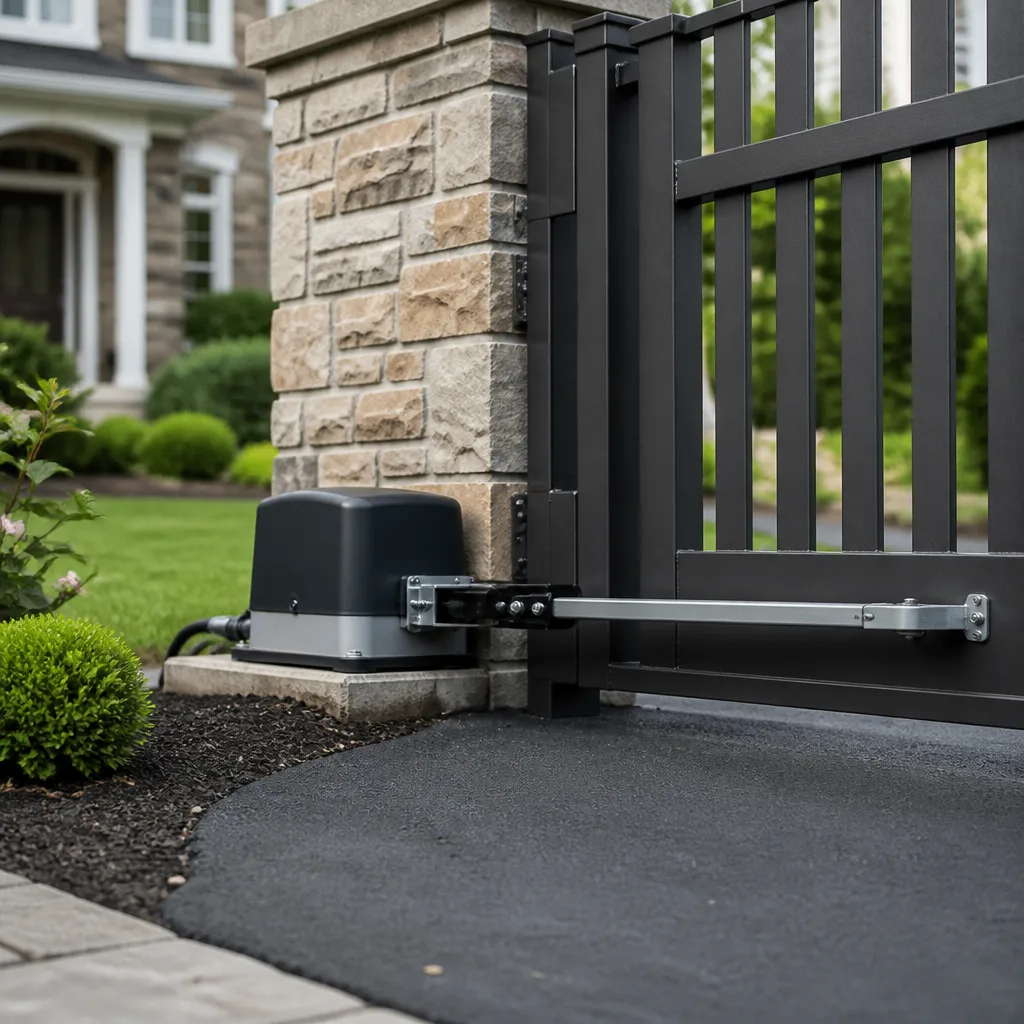
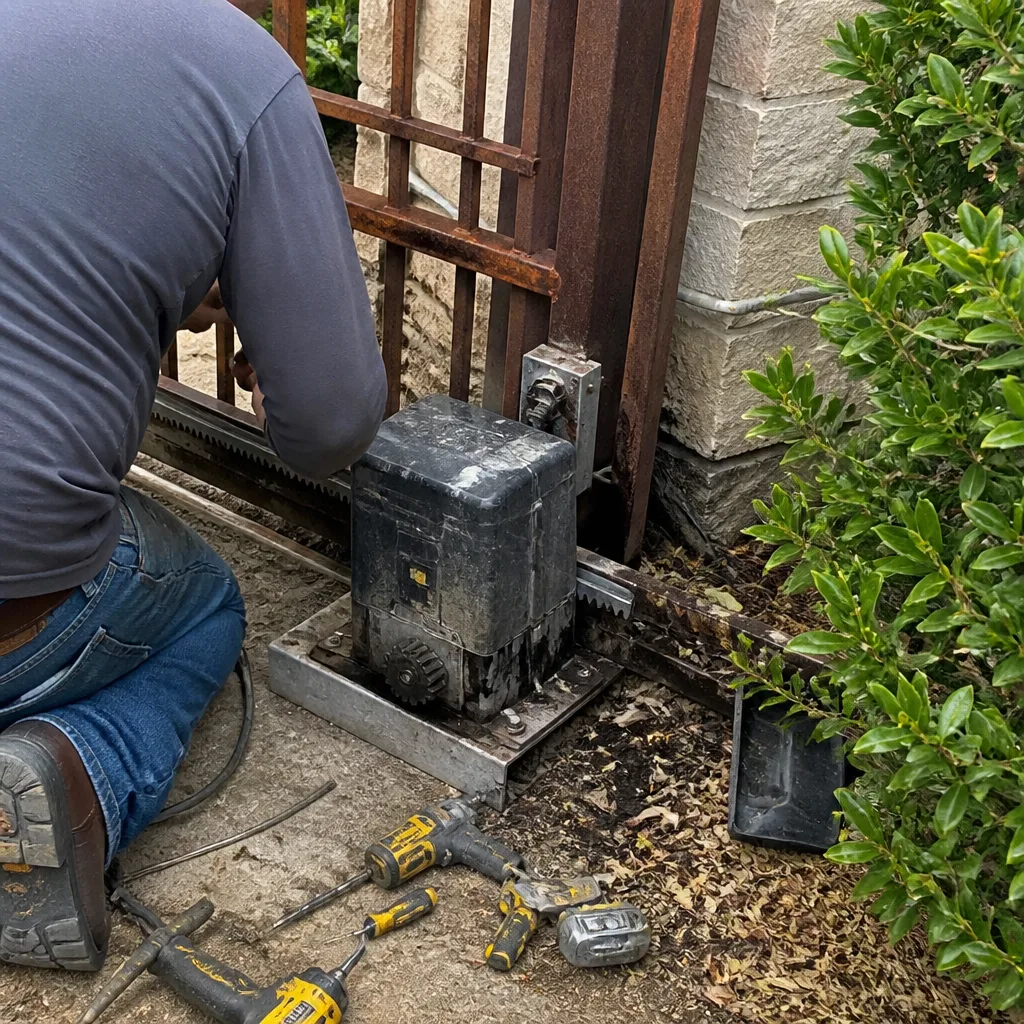 Before
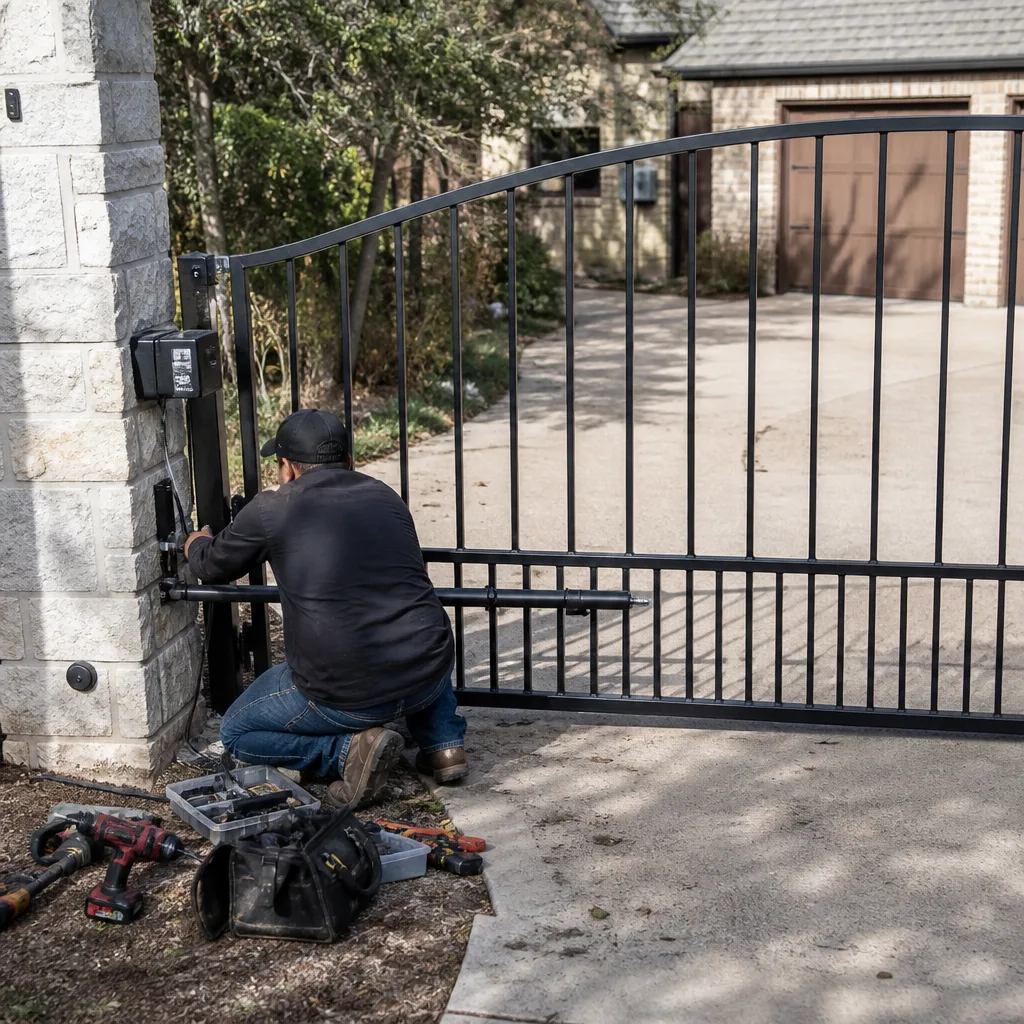 After
After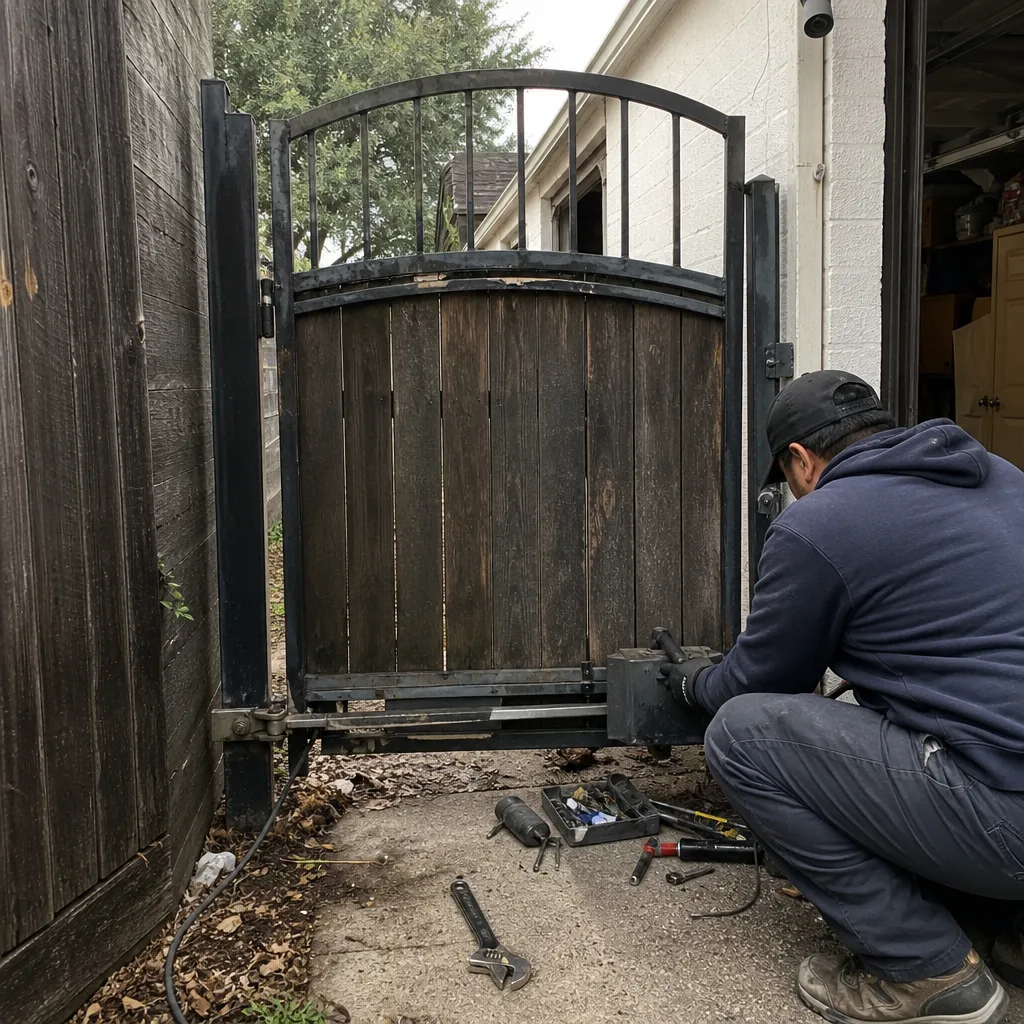 Before
 After
After Before
 After
AfterSeasonal Gate Repair Care for Fort Worth: Year-Round Homeowner’s Guide
Fort Worth gate operators rarely fail on a random Tuesday in March. They fail in clusters: the first week of sustained 95°F heat, the morning after an ice storm, the afternoon a spring squall line pushes through. We’ve logged enough service calls across Fort Worth since 2014 to see the pattern clearly. Most gate failures are foreseeable three to four weeks out if you know which component your calendar is quietly targeting. This guide maps each season to the specific failure it produces, what to inspect before it happens, and what a Fort Worth homeowner actually needs to do to keep a driveway gate running through all four of this city’s real seasons. For hands-on help, see our Gate Repair services.
Quick Answer
Seasonal gate care in Fort Worth means aligning maintenance with four distinct weather phases: heat stress (June through September), storm season (April to May and again September to October), freeze events (December through February), and the brief ideal window in late October through mid-November. The highest-value actions are a capacitor and battery check in early June, photo-eye and housing inspection after every major storm, a lubricant viscosity change before the first freeze, and a full documented inspection during the late-October window when temperatures are mild and failures are least active.
Table of Contents
- Why Fort Worth’s Climate Creates Four Distinct Gate Seasons
- Summer Heat Stress: June Through September
- Storm Season Damage: April to May and September to October
- Winter Freeze Events: December Through February
- The Optimal Maintenance Window: Late October Through Mid-November
- How to Perform a Seasonal Gate Inspection in Fort Worth
- Documenting Your Gate’s Service History for Warranty and Insurance
- Common Mistakes to Avoid
- When to Call a Professional
- Frequently Asked Questions
- The Bottom Line
BeforeAfterWhy Fort Worth’s Climate Creates Four Distinct Gate Seasons
Fort Worth doesn’t operate on the four seasons a calendar suggests. What we experience instead is closer to four stress periods, each attacking your gate through a different mechanism. Late July heat pushes the air temperature past 100°F and the surface temperature of a dark operator housing past 140°F. Spring and fall bring straight-line winds that twist panels and knock photo-eyes out of alignment by fractions of an inch. Winter drops the temperature below freezing often enough to change the viscosity of every lubricant on the gate and expose any weakness in a hydraulic system. And then there’s the window we plan our own maintenance around: late October through mid-November, when the temperature is stable, the storms have paused, and nothing is actively trying to break the equipment.
Understanding this pattern matters because it changes when you should spend money. A capacitor that will fail in August shows measurable degradation in June. A battery that will quit during an ice storm already reads weak in early October. The failure itself is sudden, but the conditions that produce it build over weeks. That’s the entire premise of seasonal care: catch the decline before the climate converts it into a breakdown.
In our experience across Fort Worth, homeowners who schedule one inspection per year in that late-October window and perform two or three ten-minute seasonal checks themselves reduce their emergency calls by more than half. It’s not complicated work. It’s just timed correctly. The sections below walk through each season’s failure pattern, what to look at, and what to do before the weather does its worst. For deeper reading, see The Complete Guide to Gate Repair in Fort Worth.
Summer Heat Stress: June Through September

What Actually Fails in the Heat
The component that fails first in Fort Worth summers is the capacitor in older operators. Capacitors store the electrical charge that starts the motor. They’re rated to operate within a temperature range, and sustained exposure above their rated ceiling shortens their lifespan dramatically. A capacitor rated for 105°F sitting inside a housing that reaches 130°F every afternoon for six weeks is going to drift out of spec. The motor still runs, but it struggles on startup. Then it hums without turning. Then it doesn’t start at all. The failure looks sudden to a homeowner, but the decline is measurable if you know what to look for: slow starts, hesitation, a gate that moves at slightly different speeds on different days.
The second heat-related failure we see regularly is battery backup systems. Most residential gate battery backups use sealed lead-acid batteries. These batteries have a well-documented relationship with heat: for every 15°F above 77°F, the expected service life drops by half. Inside a Fort Worth operator housing in August, a battery that would last five years in a mild climate is working against an environment that can age it out in two. The failure mode is predictable: the battery will show a full charge at rest, then collapse the moment it’s asked to deliver current. When the power goes out during a summer storm, the gate stays dead despite the green light on the converter.
The third pattern, quieter than the first two, is control board stress. Sustained heat accelerates the failure of electrolytic components on the board. We’ve opened housings in August where the interior exceeded 145°F. Boards in those conditions fail more from thermal cycling than from the heat itself: every afternoon the components expand, every night they contract, and after a few thousand cycles the solder joints fatigue and hairline fractures begin. The gate starts doing things that don’t make sense, opens when it should close, ignores the remote once in a while, then behaves for a day.
Early June Inspection Checklist
Perform this checklist during the first two weeks of June, before the heat locks in:
- Listen to the operator during a full open-close cycle. A soft hum before the motor engages suggests a capacitor struggling to deliver starting current. A clicking relay with no movement suggests the capacitor has already failed.
- Test the battery backup. Kill the breaker to the operator and trigger the gate with the remote. It should open and close at full speed. If it labors or fails, the battery has heat degradation. Test it in the morning before the day’s heat affects the reading.
- Inspect the operator housing ventilation. Clear any grass clippings, leaf litter, or insect nests from the housing vents. A housing that can’t breathe might as well be an oven.
- Check the gate’s ground clearance at full travel. Fort Worth’s clay soil shifts when it dries out. A gate that cleared by two inches in spring may scrape in August after the ground pulls away from the slab. A scraping gate loads the motor, which generates more heat, which accelerates component failure.
- Run the photo-eye alignment check. Heat doesn’t cause misalignment directly, but heat-related soil movement shifts posts and changes the frame geometry enough to knock a beam out of alignment. Verify the photo-eye still stops and reverses the gate during the closing cycle.
If your operator is older than eight years and you haven’t replaced the capacitor, June is the month to have it tested and replaced proactively. The part is inexpensive relative to the cost of an emergency call on a 102°F afternoon. This is the kind of work we do under the same rule that governs every job at Vance Gate Repair in Fort Worth: the written price comes before any work starts, so you never approve a repair blind.
Storm Season Damage: April to May and September to October
What High Wind Does to Gate Systems
Fort Worth storm season isn’t just about hail. The straight-line winds that precede a squall line routinely reach 50 to 70 mph, and a solid panel gate is a sail. The wind loads the entire frame, twists the posts, flexes the hinges, and shifts every component that depends on precise alignment.
The most common storm-related call we take is a photo-eye misalignment. The photo-eye, which is the infrared beam that stops the gate if something crosses the path, has a tolerance measured in fractions of an inch. A wind gust that flexes the gate post by a quarter inch is enough to throw the beam off target. The gate still operates, but the safety feature stops working properly. Sometimes the gate refuses to close because the beam can’t find its receiver. Sometimes it closes anyway because the misalignment is just enough to bypass the safety without tripping the fault. Both conditions require the same fix: realign and verify.
The second pattern is debris intrusion. Storm winds drive leaves, twigs, and roofing material into the operator housing through the same vents that cool it. Once inside, organic debris holds moisture against electrical components. That moisture accelerates corrosion on the control board. In a city with Fort Worth’s humidity patterns, a housing full of wet leaves becomes a small ecosystem of corrosion, and the board failures follow three to six months later. The storm that blew the leaves in isn’t the day the board fails. It’s the day the countdown starts.
The third pattern is mechanical: gate panels that shift on their hinges after being repeatedly loaded by wind. A panel that moves half an inch on the hinge side changes the geometry at the latch. The gate still closes, but the latch no longer seats fully. An unlatched gate in a wind event beats back and forth, and each cycle transfers force through the frame. We’ve seen gates bend their own operator arm this way.
Post-Storm Inspection, In Order
- Watch one full cycle. Look for hesitation, binding, or a gate that pauses when it should move smoothly. Binding after wind suggests the frame shifted.
- Test the safety reverse. Place a trash can in the gate’s path during closing. The gate must stop and reverse. If it doesn’t, the photo-eye or the force sensing is compromised. Fix this before using the gate normally, especially with children or pets.
- Open the operator housing. Look for debris, moisture, or insect activity. Remove dry debris. If you see visible moisture or corrosion, schedule a professional inspection before the next rain cycle.
- Check the latch and catch. Close the gate and try to move the leaf by hand. A properly latched gate will have minimal play. Play suggests hinge wear or post movement.
- Photograph everything. Not for a professional to review, but for your own record. If storm damage leads to an insurance claim, a sequence of photos showing before-and-after conditions will matter. We’ll cover this more in the documentation section below.
For repair work after a storm, the same standard applies we’ve used on every gate since 2014: a written price before we touch anything, a photo record of what we find, and a 365-day promise that if it’s not right, we make it right. We’ve written about the specifics of gate motor and opener service in Fort Worth at length if you want to understand the repair process before you ever pick up the phone.
Winter Freeze Events: December Through February
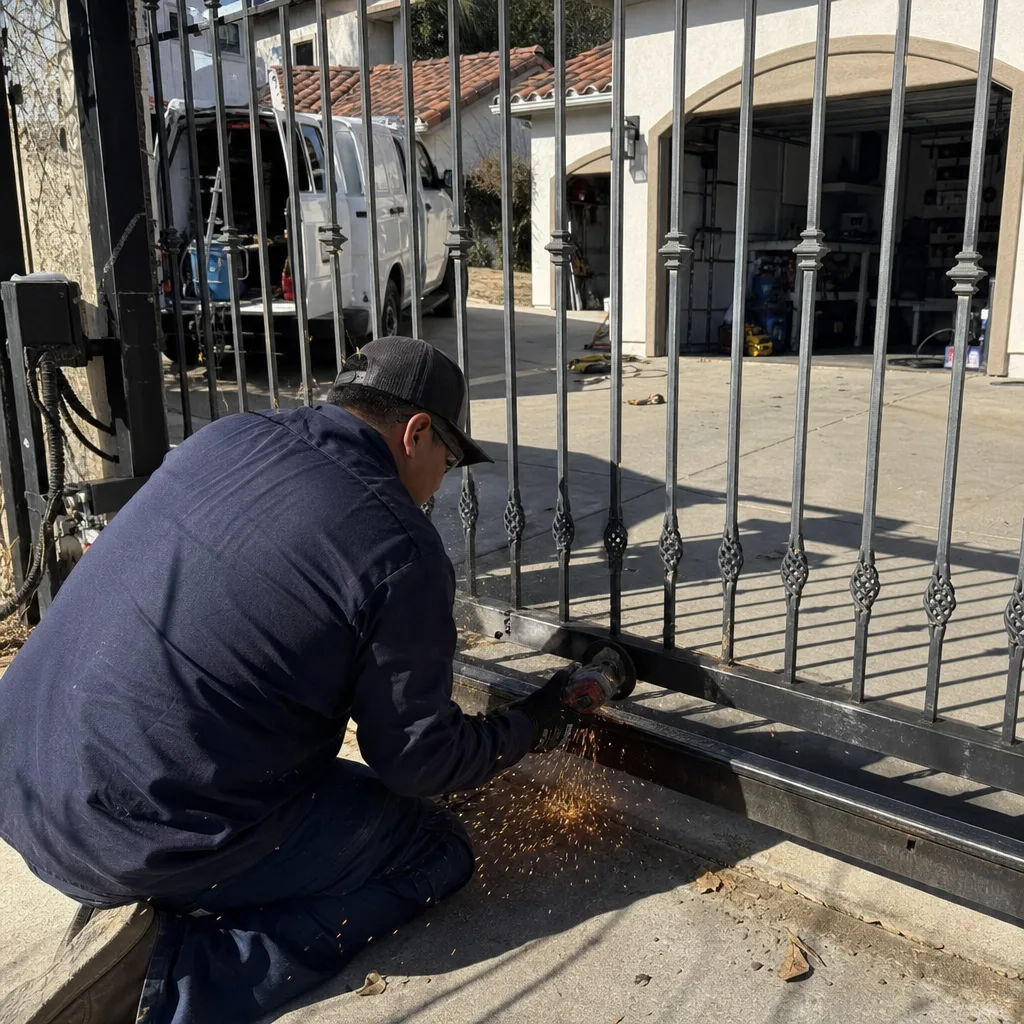
The Hydraulic Operator Freeze Pattern
Hydraulic operators, which are still common on heavier Fort Worth driveway gates, have a specific failure mode below 25°F. The hydraulic fluid inside the cylinder thickens as the temperature drops. At 25°F, the fluid may still flow but under significantly higher resistance. At 15°F, many hydraulic systems will refuse to operate entirely. The pump runs, the motor draws current, and the gate doesn’t move, or it moves in jerks, which is worse for the system than not moving at all. The jerking pressurizes the lines unevenly and can blow a seal that was otherwise perfectly fine.
What surprises homeowners is that the hydraulic failure rarely shows up during the freeze event itself. It shows up the morning after, when the ice has melted, the temperature is back to 40°F, and the gate still doesn’t work. What happened is the seal was compromised during the cold snap, and the fluid leaked out over the following days. The gate worked on Tuesday, died on Thursday, and the homeowner connects the failure to the Thursday rather than the freeze that started it on Monday.
Lubricant Viscosity and the Chain Drive Problem
The second winter pattern is simpler but catches more people by surprise. Chain drive gates and rack-and-pinion systems carry lubricant on their moving surfaces. Most residential gate lubricants are a general-purpose white lithium or a thick chain grease. These products work fine at 70°F and turn to paste at 20°F. The gate still operates, but the motor is working against congealed grease instead of a thin film. A motor that could move the gate easily in October now draws more current on every cycle. Over a winter, that extra load contributes to the same capacitor and control board wear we see in summer, just through a different mechanism.
For North Texas winters, we recommend a lubricant with a viscosity rating that stays fluid below freezing. Light machine oil or a purpose-made low-temperature chain lubricant is appropriate. The tradeoff is that light lubricants need to be reapplied more often in summer, but Fort Worth’s winter temperatures don’t demand a heavy grease, so the lighter product is the right call from November through March. Switch back to a mid-weight lubricant in April if you prefer, or just reapply more frequently through the summer months.
The Freeze Prep Checklist
- If you have a hydraulic operator, test it on the first cold morning. A day where the high is below 35°F is the right test condition. If the gate moves slowly or jerks, the fluid may need replacement before the next deeper freeze.
- Clean and re-lubricate chain or rack surfaces before the first freeze. Remove the old grease first. Introducing new lubricant over congealed paste just makes more paste.
- Check the weep holes and drainage paths around the gate posts. Standing water that freezes around a post can displace the post as it expands. This is the same soil-shift mechanism we see in summer, just faster and more aggressive.
- Charge-check the battery backup again in late November. A battery that survived summer may still be compromised. A freeze event is when you need it most, because that’s when the power lines are also stressed.
If the gate fails during a freeze event, the repair is often straightforward once the temperature stabilizes. Before you call anyone, take a photo of the operator, note whether it hums or is silent, and check whether the gate moves manually. That information saves a diagnostic visit. We work on most gate installations in Fort Worth and service whatever motor is already on the property, including Ghost Controls, DoorKing, and Mighty Mule systems, which are all common in this market.
The Optimal Maintenance Window: Late October Through Mid-November
Fort Worth actually has one maintenance window that’s close to ideal: the stretch between the last 90°F day and the first hard freeze. Most years that runs from late October through mid-November. The temperature is stable in the 60s and 70s. The soil has stopped shifting from summer drought and hasn’t yet begun shifting from winter moisture. The storms have passed. Nothing is actively attacking the gate, which means everything that’s wrong with it is visible and measurable.
This is the window for the comprehensive annual service. Not the ten-minute seasonal checks, but the real work: capacitor testing, battery load test, board inspection, photo-eye alignment, hinge and post check, lubrication, and a full function test of every safety feature. If you’re going to spend money on your gate in a given year, this is when the money buys the most.
What to Complete During This Window
- Full electrical inspection. Capacitor, battery, transformer, and wiring. Look for heat discoloration on the board, swelling on the capacitor, and voltage that drifts under load.
- Full mechanical inspection. Hinges, posts, latch, roller guides, and operator arm. Check for play, rust, and any movement that shouldn’t be there.
- Safety system verification. Photo-eye alignment, force sensing, obstacle reversal. Test each one three times. A safety feature that works once and fails twice is a broken safety feature.
- Lubrication service. Clean and re-lubricate all moving surfaces with the appropriate viscosity for the coming winter.
- Documentation. A written record of what was found, what was measured, and what was done. We cover the documentation standard in the next section; it’s not optional for warranty and insurance purposes.
This is also the time to make the larger decisions. If the operator is approaching the end of its service life, you want that knowledge in November, not in a June emergency. A planned replacement in the maintenance window is calmer, more flexible on scheduling, and lets you make a brand choice on your own timeline rather than whatever is available the day the old one dies. We service whatever motor is already on the property, but if replacement is the right call, brands like Elite and DoorKing have strong parts availability in the Fort Worth market, and we can quote both paths so the decision is yours.
How to Perform a Seasonal Gate Inspection in Fort Worth
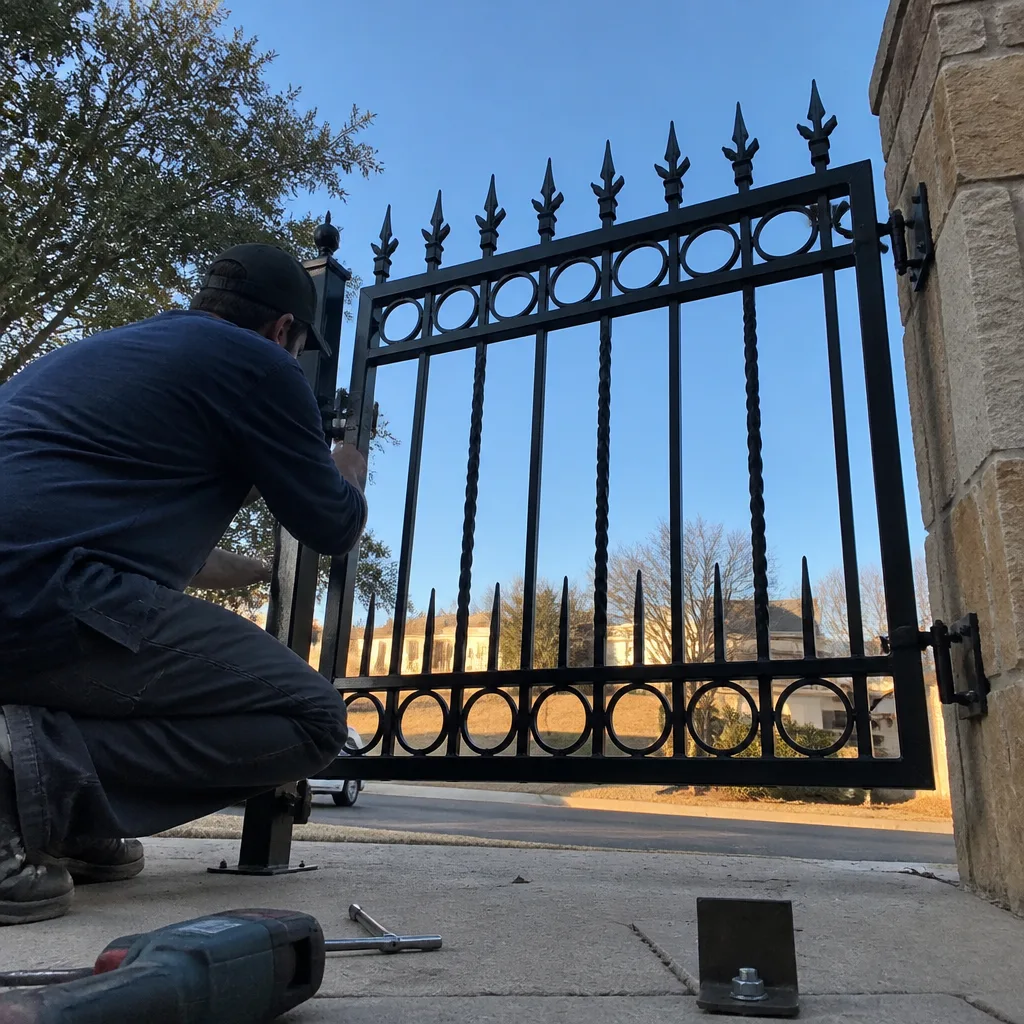
This section walks through the four seasonal checks in order. Each one takes ten to fifteen minutes and requires no specialty tools. The purpose is to catch the slow changes before they become sudden failures. If anything checks out wrong, call before it gets worse, or bring the photos and measurements to us for a free second opinion on any written estimate you already have.
Spring Check (March to April)
Focus on winter damage and storm readiness.
- Inspect the gate surface for cracks or rust blooms that developed over winter. Fort Worth’s freeze-thaw cycles stress welds and paint.
- Test the full open-close cycle three times. Listen for new sounds, vibration, or hesitation that wasn’t there in the fall.
- Verify the battery backup. The winter may have depleted it. A spring test tells you if it’s still holding a charge.
- Check the photo-eye alignment. Soil movement from winter moisture will have shifted the geometry.
- Clean the operator housing. Remove winter debris and check for moisture before the first heavy rain.
Summer Check (June to August)
Focus on heat stress and soil shrinkage. The full checklist is in the summer section above. The abbreviated version is: listen for slow starts, test the battery in the morning, clear the housing vents, check ground clearance, and verify the safety reverse. Do this once in early June and once in late July if the summer is particularly hot.
Fall Check (October and the Optimal Window)
This is the comprehensive service window described above. The fall check includes everything: electrical, mechanical, safety systems, lubrication, and documentation. If you only do one thorough inspection per year, this is the one.
Winter Check (December to February)
Focus on cold-weather function and freeze damage. The full checklist is in the winter section above. The abbreviated version is: test the operator on a cold morning, re-lubricate if needed, check drainage and standing water, and keep an eye on the battery. If a freeze event is forecast, run the gate through one full cycle the day before and one the morning after.
Documenting Your Gate’s Service History for Warranty and Insurance
Most homeowners do maintenance and never write any of it down. Then a warranty claim comes up, or an insurance adjuster asks about the gate’s service history, and there’s nothing to show. The documentation standard at Vance Gate Repair came from commercial access-control work, where every adjustment and replacement has to be recorded because the next technician to touch that system might be on a different company’s payroll. That habit moved into our residential work because it’s simply the right way to run a gate, and it protects the homeowner as much as it protects the technician.
We leave every job with a documented photo record: what was found, what was adjusted, what was installed. It’s the same wiring-diagram habit Adrian Vance built on commercial sites starting in 2014, and it’s the foundation of The Haven Standard, which governs every job we do. Under Clause 4 (Evidence on every job), the photo record is included on every visit at no additional charge.
For the homeowner doing their own seasonal checks, a simple version of this works. Keep a note on your phone with the date, the temperature, what you checked, and what you found. Take a photo of anything that looks wrong. If your gate has a warranty claim or an insurance claim attached to it, a timeline of documented seasonal checks is evidence that the failure wasn’t neglect. The photo log also gives any future technician a baseline for what has changed, which often shortens the diagnostic process from an hour to fifteen minutes.
Common Mistakes to Avoid
- Skipping the June battery test. A battery that fails in July would have shown weakness in June. The test takes five minutes and tells you whether you’ll have a working gate during the summer storm that takes out the power.
- Using heavy grease year-round. Chain grease that works in June turns to paste in January, and the motor pays for it. Swap to a light or low-temperature lubricant before the first freeze.
- Ignoring a photo-eye after a wind event. A misaligned photo-eye may allow the gate to keep working, but the safety system is compromised. In Fort Worth’s storm season, this is the most common preventable safety failure we see.
- Waiting until the gate fails to schedule maintenance. By the time a component has failed, the repair is more expensive than the prevention would have been, and you’re scheduling on the weather’s timeline instead of your own.
- Not documenting anything. A gate with no service history is a gate where every new technician starts from zero. Ten minutes of notes twice a year saves real money across the life of the equipment.
- Cleaning the housing vents. Clogged vents turn a Fort Worth summer into an oven for the control board. Leaves, grass clippings, and dirt do damage quietly.
- Forgetting the ground clearance check. Fort Worth’s clay soil moves more than people think. A gate that clears fine in May can scrape the driveway by August, and a scraping gate kills motors.
When to Call a Professional
Call when the gate hums but doesn’t move, when it moves but hesitates or jerks, when the safety reverse fails a test, when the operator housing shows visible corrosion or moisture, or when you’ve done your own inspection and something reads wrong but you don’t know what it means. Also call after any storm that left visible damage to the panel or the posts. A gate that’s binding or scraping is a gate that’s wearing out its own motor. Vance Gate Repair Fort Worth offers free estimates in Fort Worth, (817) 476-9945, and we’ll quote a written price before any work starts so you know what you’re approving.
Frequently Asked Questions
A basic seasonal inspection typically runs between $95 and $175 depending on the gate type and whether any adjustments are needed during the visit. A comprehensive annual service with lubrication, capacitor testing, battery load test, safety verification, and documentation usually falls between $200 and $400 for a standard single-leaf residential gate. Every price is quoted in writing before any work starts. Call (817) 476-9945 for an exact quote for your gate, estimates are free.
One comprehensive service per year during the late-October to mid-November window is the baseline. Add seasonal checks in early June, after significant storms, and before forecast freeze events. The goal is to catch component decline before the weather converts it into a failure, and Fort Worth’s climate makes the annual pattern non-negotiable if you want a gate that starts every morning.
The most common cause is a capacitor that degraded through the early heat and finally lost enough capacitance to start the motor. The second most common is a battery backup that passed a spring test but couldn’t survive the summer heat inside the operator housing. Both failures look sudden, but both are detectable in advance with a June inspection.
Both. A hydraulic operator can refuse to move during a freeze and return to normal when it warms, but the repeated freeze-thaw cycle ages seals and can cause a leak that doesn’t show up until later. A gate that works through the winter without issue is a gate that’s properly lubricated and in good mechanical condition.
The ten-minute checks, like listening for hesitation, testing the safety reverse, and clearing the housing vents, are straightforward DIY tasks. The comprehensive annual service, including capacitor testing and battery load testing, requires tools and experience most homeowners don’t have. The practical approach: do your own seasonal checks, and bring in a professional for the fall window service.
We work on Ghost Controls, DoorKing, Elite, and Mighty Mule systems, along with the full range of major gate automation brands. Our approach is to repair whatever is already on the property rather than steering toward a replacement unless the existing equipment has genuinely reached the end of its service life.
The Bottom Line
Fort Worth gates fail in patterns, and the patterns follow the calendar. Heat kills capacitors and batteries in summer. Storms twist frames and misalign photo-eyes. Freezes congeal lubricant and stress hydraulic seals. The maintenance window that matters is late October through mid-November, and the checks that matter are the ones you do before the season turns, not after. Do the inspections, document what you find, and call before a small issue becomes a big repair. Explore more guides & resources for year-round gate care. A gate that’s cared for seasonally is a gate that opens every morning, closes every night, and doesn’t surprise anyone at the worst possible time.
Written by Adrian Vance, Owner at Vance Gate Repair Fort Worth, serving Fort Worth since 2014.